
Running a bus or rail network means juggling a flood of live information. MIT’s Transit Lab has now received $2.1 million from Google.org to build a system that pulls it together. The project, called the Public Transit Intelligence Hub, or PTIQ, aims to link transit monitoring, operations control and passenger communication in one AI-assisted platform.
A grant from a global challenge
Google’s philanthropic arm announced the money on 15 September. PTIQ is one of 15 projects chosen worldwide in the Google.org Impact Challenge: AI for Government Innovation, which backs non-profits, social enterprises and universities building AI-based public services. The grant runs for three years, and Google.org will add pro bono help from its engineers and AI product specialists.
The problem: information scattered across screens
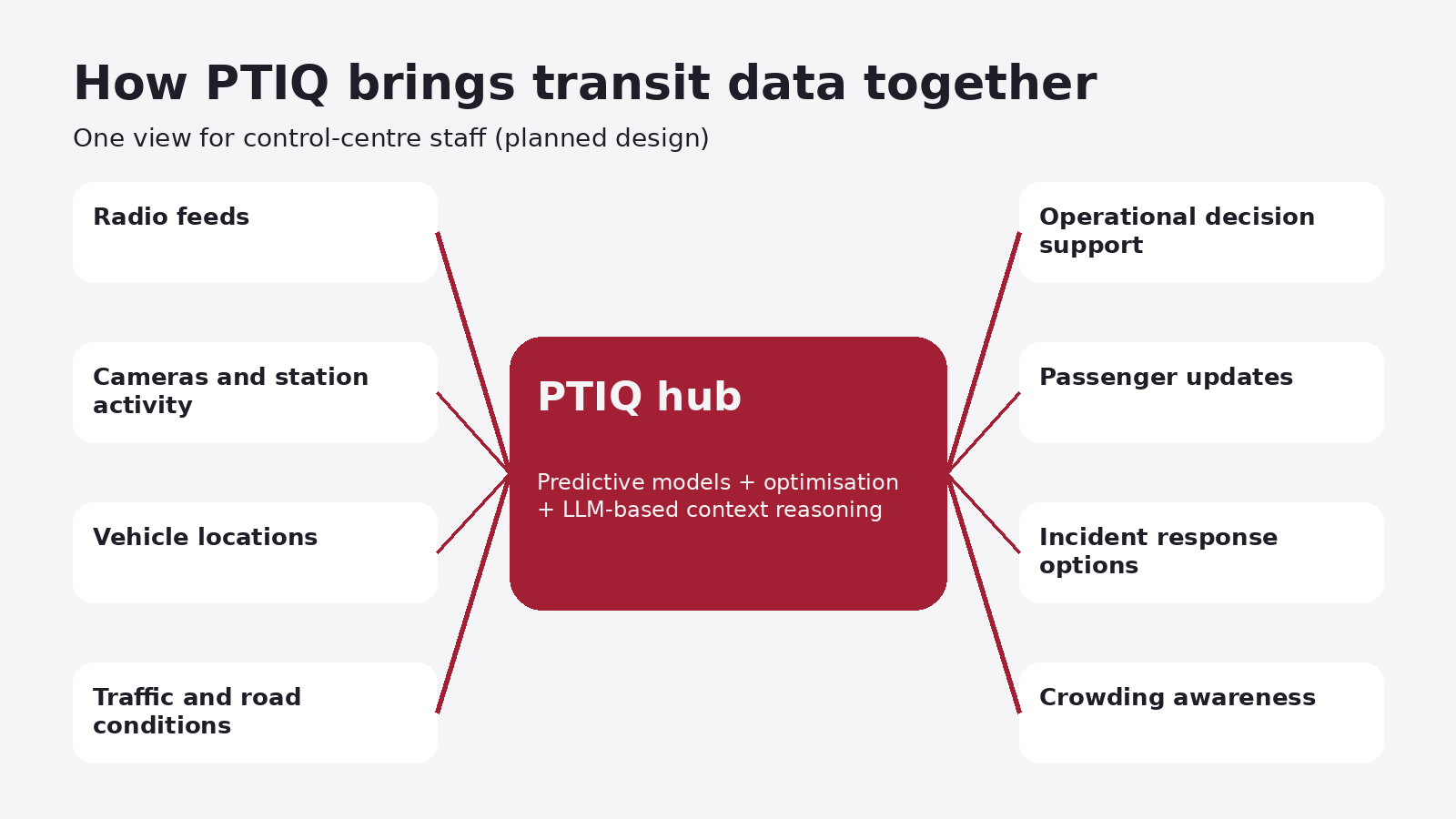
Inside a transit control centre, staff follow radio traffic, video feeds and screens that show vehicle positions, station activity, traffic and road conditions. These sources usually sit in separate systems, so nobody has a single picture of how the network is doing. PTIQ will gather data from those agency systems into one interface for control-room staff.
How it is meant to work
The decision-support tool combines three ingredients: predictive models, optimisation engines and reasoning built on large language models that understands context. Together they should help staff judge what is happening and decide how to respond as events unfold, and also support timely messages to passengers.
The team is firm that people stay in charge. Awad Abdelhalim, the lab’s associate director and technical lead, explained that the aim is not to automate the decisions but to ensure the people who make them have the best available information. He noted that running a transit system is a messy, multi-stakeholder job with no single right answer, which makes it very different from the maths and coding tasks often used to test AI models.
Trust and fit come first
Professor Jinhua Zhao, the other principal investigator, said that after years of work with agencies in cities such as Washington, Chicago, London, Boston, Tokyo and Hong Kong, the question has changed. It is no longer whether AI can do a task, but whether it can function inside the organisation and whether staff trust it. The project draws on the Transit Research Consortium, with researchers from the Transit Lab, the MIT Mobility Initiative and Northeastern University.
Promises still to be proven
The expected benefits are so far hopes rather than results. Programme manager Jim Aloisi said the team expects faster response to incidents, less crowding at platforms and bus stops, and better passenger information. Those claims will need testing in real control rooms over the three-year project.
Source: reporting by AI News (artificialintelligence-news.com), 1 October 2026, and Google.org’s announcement.