
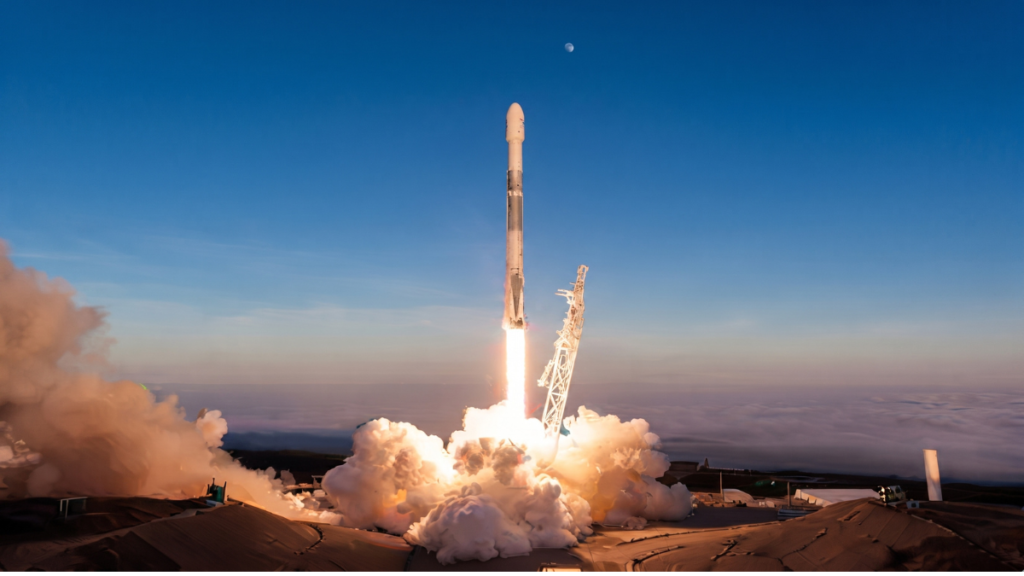
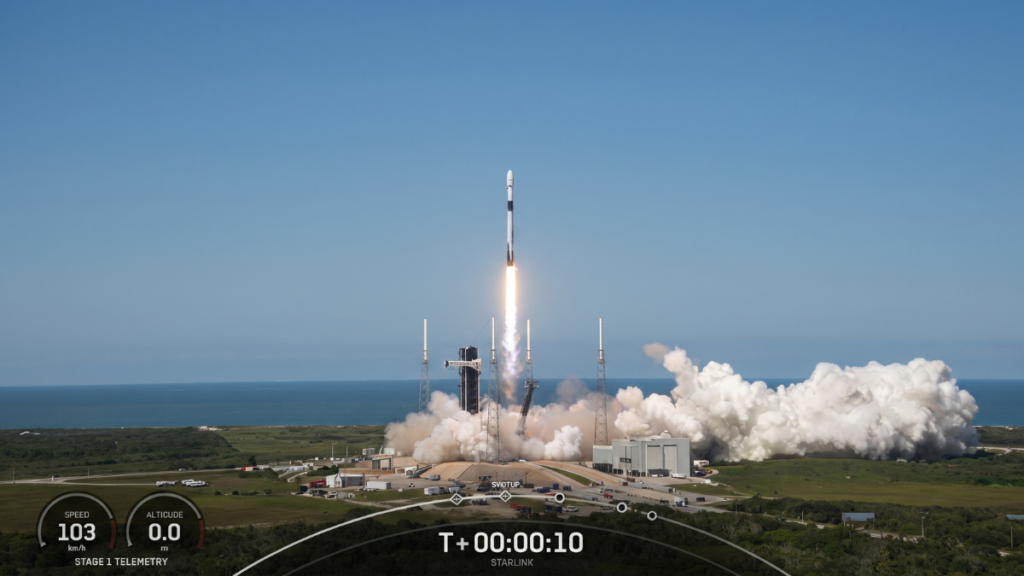
SpaceX has done it again, pushing the boundaries of aerospace engineering and modern satellite communications. In another monumental step for space exploration, a seasoned SpaceX Falcon 9 rocket successfully thundered into the skies, carrying a fresh batch of Starlink satellites into low-Earth orbit.
This latest flight not only underscores the unmatched reliability of the company’s workhorse launch vehicle but also highlights how reusable rocket technology continues to redefine the economics of space flight.
Table of Contents
Mission Highlights: A Seamless Ascent
The mission showcased the textbook precision that has become synonymous with a SpaceX rocket launch. Liftoff occurred seamlessly, lighting up the sky as the Falcon 9 mission profile executed precisely as planned.
- Payload: A fresh configuration of advanced Starlink satellites designed to fortify global high-speed broadband coverage.
- Launch Vehicle: The iconic two-stage Falcon 9, capitalizing on its flight-proven architecture.
- Flight Cadence: Part of an increasingly dense SpaceX launch schedule that sees multiple flights per week across both U.S. coasts.
For space enthusiasts tracking a Falcon 9 launch today, the rhythm of these operations highlights just how routine orbital delivery has become under SpaceX’s revolutionary operational model—though each flight remains an awe-inspiring technological spectacle.
The Core of Innovation: Falcon 9 Booster Landing
The crown jewel of the mission—as is customary for modern SpaceX flights—was the flawless execution of the Falcon 9 booster landing.
Following stage separation, the first-stage booster began its controlled descent back to Earth. Utilizing precisely timed entry and landing burns, the booster successfully touched down on one of SpaceX’s autonomous droneships stationed at sea.
[Liftoff] ---> [Stage Separation] ---> [Entry Burn] ---> [Landing Burn] ---> [Successful Droneship Touchdown]
Reusing the Falcon 9 booster drastically cuts down the turnaround time and financial overhead required to build orbital-class hardware. Every successful landing adds crucial flight data to SpaceX’s engineering logs, proving that rocket components can endure repeated journeys to the edge of space and back.
Expanding the Starlink Constellation
The primary beneficiaries of this flight are the Starlink satellites housed inside the rocket’s fairing. Once deployed into low-Earth orbit, these spacecraft use onboard ion thrusters to drift into their operational planes, integrating into the larger megaconstellation.
Why This Matters for Global Connectivity:
- Bridging the Digital Divide: Starlink provides high-speed, low-latency internet to remote, rural, and underserved regions globally where traditional fiber or cable infrastructure cannot reach.
- Resilient Networks: The expanding constellation ensures seamless handoffs and continuous coverage, even in challenging maritime or aviation environments.
Redefining Space Exploration Economics
The ongoing success of the Falcon 9 ecosystem demonstrates why reusable rocket technology remains the holy grail of modern aerospace. By recovering and flying boosters multiple times, SpaceX has fundamentally changed how governments, commercial entities, and scientific researchers access space.
As the SpaceX launch schedule charges full steam ahead with dozens of flights lined up for national security, commercial payloads, and internal deployments, the Falcon 9 stands tall as the most flown active rocket family in history—paving the way for the future of interplanetary transport with Starship.