
Finals season doesn’t care that you have four classes, a part-time job, and a group project with one person who never replies. If you’re wondering how to use ChatGPT to study without just outsourcing your brain, you’re asking the right question. Used well, ChatGPT can turn a 3-hour reading assignment into a 45-minute active study session. Used badly, it can quietly wreck your grades and your understanding. This guide shows you exactly where that line is.

Key Takeaways
- ChatGPT works best as a study tutor, not a homework machine — the difference is whether you’re doing the thinking
- Specific chatgpt study prompts (with your notes pasted in) beat vague ones like “explain photosynthesis” every time
- Free ChatGPT (GPT-4o mini access) is enough for 90% of student use cases; Plus helps with heavy course loads
- Always verify facts, dates, and citations — ChatGPT can be confidently wrong
- Combine it with flashcard tools and your actual class materials for the best results
Table of Contents
Why Students Are Turning to ChatGPT as a Study Tool
The appeal is simple: ChatGPT is available at 2 a.m. when your professor isn’t, it never gets impatient with repeated questions, and it can adapt explanations to your level instantly. A 2023 Pew Research Center survey found that a growing share of US teens report using ChatGPT for schoolwork, with usage roughly doubling year over year among students aware of the tool.
That growth isn’t surprising. What matters more is how students are using it — because the outcome depends entirely on the method, not the tool itself.
Use ChatGPT to Study Tutor: The Core Method
The single biggest mindset shift is this: stop asking ChatGPT to give you answers, and start asking it to test you on answers you already attempted.
Step 1: Feed It Your Actual Material
Paste your lecture notes, textbook chapter, or slides directly into the chat before asking questions. Generic answers about “the French Revolution” are far less useful than answers grounded in what your specific professor emphasized.
Step 2: Ask It to Quiz You, Not Tell You
This is the core of using ChatGPT as a study tutor rather than a shortcut. Instead of “summarize chapter 7,” try “quiz me on chapter 7 one question at a time, and don’t give me the answer until I respond.”
Step 3: Ask for the “Why,” Not Just the “What”
Follow up wrong answers with “why was I wrong, and what’s a memory trick to avoid that mistake again.” This forces retrieval practice, which cognitive science research (including work popularized by Barbara Oakley’s Learning How to Learn) consistently shows beats passive re-reading.
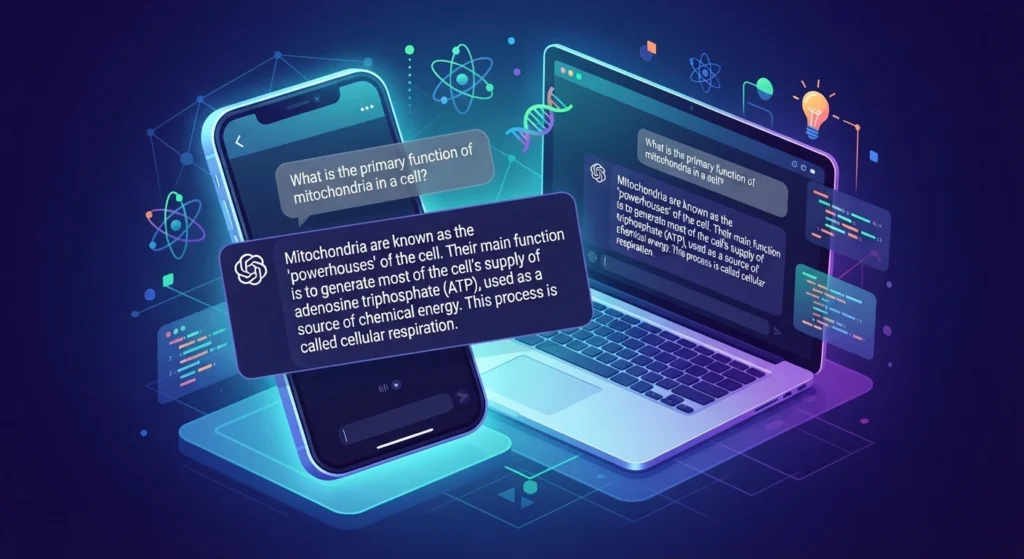
7 ChatGPT Study Prompts That Actually Work
Copy-paste and adjust these chatgpt study prompts for your own material:
- “Here are my notes: [paste]. Quiz me with 10 questions, one at a time, increasing in difficulty.”
- “Explain this concept like I’m a beginner, then explain it again like I’m being tested on it in an exam.”
- “Turn this paragraph into 5 flashcard-style Q&A pairs.”
- “I got this practice problem wrong: [paste]. Don’t solve it — ask me guiding questions until I solve it myself.”
- “Summarize this chapter in exactly 150 words, then list 3 things a professor might ask about it.”
- “Create a study schedule for this topic across the next 5 days, 30 minutes a day.”
- “Here’s my essay outline: [paste]. Poke holes in my argument like a strict grader would.”
My Experience with How to Use ChatGPT to Study Smarter, Not Harder
I tested this workflow myself over two weeks while preparing content for AI Product News, using it the way a busy student would — evenings, tired, juggling other work. I pasted in a dense 12-page research summary and asked ChatGPT to quiz me instead of summarize it. The difference was immediate: when I just asked for a summary, I could “understand” it while reading and forget it an hour later. When I was quizzed and had to retrieve the answer myself, retention held up noticeably better the next day.
The limitation showed up on a technical, numbers-heavy section. ChatGPT confidently generated a quiz question with an incorrect statistic that wasn’t in my source material — it had blended it in from general training data. I only caught it because I cross-checked against the original PDF. That’s the real risk: it sounds equally confident whether it’s right or wrong, so you still have to verify anything factual before it goes on a flashcard or, worse, into an exam answer.
Net result: faster review sessions, better recall on quizzed material, but zero trust for raw facts without a source check.
Comparison: ChatGPT vs. Other AI Study Tools
| Tool | Price | Best Feature | Best For | Rating |
|---|---|---|---|---|
| ChatGPT (Free/Plus) | Free / $20/mo | Conversational tutoring, custom prompts | Open-ended studying, essay feedback | 4.5/5 |
| Quizlet + AI | Free / $7.99/mo | Auto-generated flashcards | Memorization, spaced repetition | 4.2/5 |
| Notion AI | Included in paid plans | Notes + AI summarization in one place | Organizing lecture notes | 4.0/5 |
| Claude (Anthropic) | Free / $20/mo | Long-document analysis, careful reasoning | Reading dense textbooks/papers | 4.4/5 |
| Grammarly AI | Free / $12/mo | Writing and citation checks | Essay polishing, not tutoring | 3.9/5 |
Pros and Cons of Using ChatGPT to Study
Pros:
- Available 24/7, no scheduling a tutor session
- Adapts explanations to your exact confusion, not a generic textbook level
- Free tier is genuinely usable for most coursework
- Great for turning passive notes into active quizzes
Cons:
- Can generate confidently wrong facts, dates, or citations
- Easy to misuse as an answer machine instead of a tutor
- Doesn’t know your specific professor’s grading rubric unless you tell it
- Over-reliance can weaken your own problem-solving muscle over time
A Simple Weekly Study Routine Using ChatGPT
- Monday: Paste the week’s readings, ask for a 150-word summary plus 3 likely exam questions
- Wednesday: Quiz mode on the same material, one question at a time
- Friday: Ask ChatGPT to roleplay as a strict grader reviewing your practice essay or problem set
- Sunday: Ask for a spaced-repetition schedule for anything you got wrong twice
FAQ
Is it cheating to use ChatGPT to study?
No, if you’re using it to quiz yourself or clarify concepts. It becomes cheating if you submit ChatGPT’s raw output as your own work — check your school’s AI policy first.
Can ChatGPT replace a real tutor?
Not fully. It’s excellent for practice and explanation but can’t observe your handwriting, body language, or catch subtle misunderstandings the way a human tutor can.
What’s the best ChatGPT prompt for studying?
“Quiz me on [topic] one question at a time, and explain why I’m wrong before giving the right answer” consistently outperforms simple summary requests.
Is the free version of ChatGPT good enough for students?
Yes, for most coursework. GPT-4o mini access on the free tier handles quizzing, summarizing, and explaining well; Plus mainly helps with heavier usage limits.
Does ChatGPT give wrong answers?
Yes, it can. Always verify facts, statistics, and citations against your actual course materials or a primary source before trusting them.
Can ChatGPT help write my essays?
It can help outline, structure, and critique essays, but writing full essays with it risks plagiarism violations and weakens your own writing skills long-term.
How do I stop relying on ChatGPT too much?
Use the “quiz me, don’t tell me” approach — it forces you to produce the answer yourself, which is the actual skill you’re being graded on.
Is ChatGPT or Claude better for studying?
ChatGPT tends to be faster and more casual for quick Q&A; Claude often handles longer documents and nuanced reasoning more carefully. Many students use both.
Conclusion
Used as a study tutor rather than an answer engine, ChatGPT can genuinely cut your study time while improving recall — but only if you keep yourself in the driver’s seat and verify anything factual. Start with one prompt from this guide on your next assignment, and build the quiz-first habit from there.
Comparing ChatGPT to Other AI Tools for Studying
ChatGPT isn’t the only chatbot students are turning to for schoolwork. A Pew Research Center survey found that the share of U.S. teens using ChatGPT for schoolwork rose to 26% in 2024, up from 13% the year before, showing just how mainstream AI-assisted studying has become. If you’re deciding between chatbots, our Grok vs. ChatGPT 2026 comparison breaks down which one handles reasoning, real-time info, and study-style prompts better. For a deeper look at the research itself, see the Pew Research Center report on teen AI use.