
Key Takeaways

- OpenAI GPT-6 Astra launched September 3, 2026, replacing GPT-5.6 Sol as OpenAI’s flagship model.
- It’s priced at $10 / $50 per million input/output tokens, with a 1,050,000-token context window.
- GPT-6 Astra benchmarks include 97.6% on FrontierMath Tier 4, 99.9% on ARC-AGI-3, and 72.6% on OSWorld 2.0 computer-use tasks.
- It’s the first OpenAI model to cross the “Critical” cybersecurity capability threshold, which comes with tighter safety restrictions.
- It’s live now in ChatGPT Plus/Pro/Business/Enterprise, the OpenAI API (
gpt-6-astra), Microsoft Azure, and AWS Bedrock.
Table of Contents
If you’re not deep into AI research, most “new model dropped” posts are noise — bigger numbers, same vague promises. This one is different, and if you use AI for real work (content, code, research, ops), it’s worth five minutes to actually understand what changed. Not familiar with what a “model” even is in the first place? Start with What Is an AI Model? How AI Models Work (Beginner’s 2026) and come back — the rest of this will make more sense.
What Is OpenAI GPT-6 Astra ?
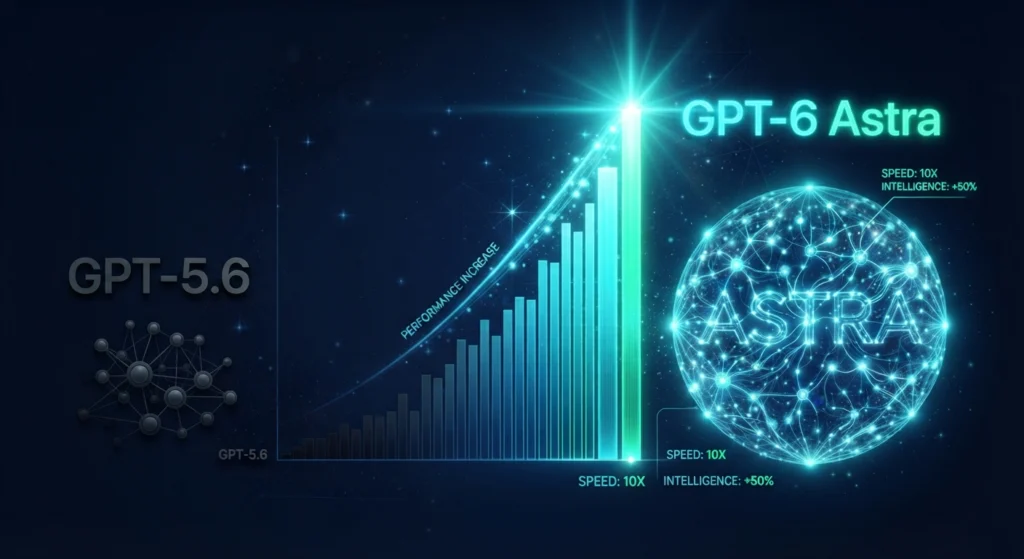
OpenAI GPT-6 Astra is OpenAI’s new flagship model, announced and rolled out starting September 3, 2026. It replaces GPT-5.6 Sol as the company’s most capable system.
The framing matters here. OpenAI isn’t selling Astra as “a chatbot with a bigger vocabulary.” It’s selling it as an AI agent — something that can sit at a computer, use a browser, write a finished document, hold onto a coding project for hours, and carry out a task in multiple steps without a human re-prompting it after every move. OpenAI’s own examples include things like filling out a full tax return or building a working prototype from a single brief. President Greg Brockman went further, suggesting this release could eventually be seen as an early marker on the road to AGI — OpenAI’s own term for a system that can do all economically valuable work as well as a human.
Read that claim for what it is: a bet about the future, not a benchmark score. The benchmark scores are separate, and they’re the part actually worth your attention.
GPT-6 Astra Features

Strip away the launch-day language and here’s what actually changed:
- Task persistence. Astra is specifically tuned to stay on task, respect scope, and finish multi-step workflows — historically the weak point of “AI agents,” which tend to drift or lose the thread halfway through.
- Native computer use. It can operate a screen or browser directly — clicking, filling forms, navigating apps — rather than just describing what to do.
- A much longer memory. A 1,050,000-token context window means it can hold an entire codebase, a long research brief, or a full project history in a single session.
- A faster coding harness. OpenAI’s updated Codex tooling reportedly completes tasks 1.9x faster than the GPT-5.6 Sol setup on the Mind2Web benchmark.
- Privacy options for business use. Zero Data Retention is available for eligible API customers, alongside a new Private Safety Processing system designed to keep safety monitoring intact without exposing customer data.
- A gated Pro tier. “GPT-6 Astra Pro” ships for Pro, Business, and Enterprise ChatGPT plans. At the enterprise level, it’s off by default — an admin has to switch it on.
OpenAI GPT-6 Astra Benchmarks
| Benchmark | GPT-6 Astra Score | What It Actually Measures |
|---|---|---|
| FrontierMath Tier 4 | 97.6% | Graduate/research-level math reasoning |
| ARC-AGI-3 | 99.9% (provider harness) | Solving novel problems it wasn’t trained on |
| OSWorld 2.0 (computer use) | 72.6%, ~47% faster than Sol | Actually operating a computer to finish a task |
| ExploitBench | 100% | Finding and exploiting security vulnerabilities |
| Mind2Web (Codex harness) | 1.9x faster than GPT-5.6 Sol | Completing agentic web-based tasks |
The number to actually sit with is ExploitBench. According to OpenAI’s safety overview, Astra is the first OpenAI model to cross the “Critical” threshold for cyber capability under the company’s Preparedness Framework — meaning that, with the right tools and access, it can independently discover unknown vulnerabilities and build new ways to exploit them, without a person guiding every step. That’s why the public release restricts certain advanced cybersecurity prompts, and why broader, less-restricted access is rolling out gradually through what OpenAI calls its Daybreak program.
OpenAI GPT-6 Astra vs GPT-5.6: What Actually Changed
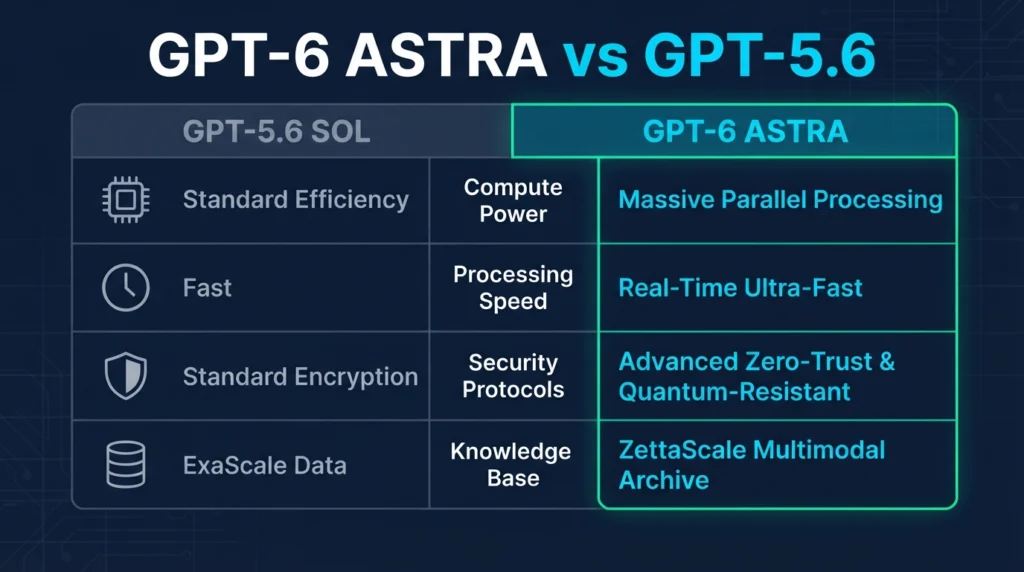
| GPT-5.6 Sol | GPT-6 Astra | |
|---|---|---|
| Role | Previous flagship | Current flagship |
| Computer use (OSWorld 2.0) | Slower, lower score | 72.6%, ~47% less time per task |
| Cybersecurity capability | Below Critical | Crosses Critical threshold |
| Prompt injection resistance | Baseline | Significantly more robust |
| Safety on high-risk requests | Baseline | Safer overall, fewer unnecessary refusals |
| Context window | Smaller | 1,050,000 tokens |
| Under-18 safety handling | Baseline | More consistent age-appropriate boundaries |
The honest takeaway from OpenAI’s system card isn’t “smarter model.” It’s “more reliable operator.” The gap that used to break agentic workflows — a long task falling apart three steps in — is specifically what this generation targets. For a deeper dive into full scores against Claude and Gemini, DataCamp’s benchmark breakdown is worth a look, and OpenRouter’s pricing page has live API pricing and throughput by provider.
GPT-6 Astra as an AI Agent: Where It Actually Helps
Set the AGI talk aside. Here’s where this is genuinely useful today:
- Software engineering — long coding sessions that hold context instead of forgetting earlier decisions.
- Deep research and document creation — a multi-step research task compiled into one finished draft, not a pile of disconnected notes.
- Computer-use automation — navigating real apps and forms without a human clicking through each screen.
- Secure code review and patching — Astra can assist defenders directly today, though it still refuses to generate offensive exploit code in the current public release.
If your content strategy already leans on AI-assisted workflows, it’s also worth understanding how model upgrades like this interact with how you get found — see Generative Engine Optimization for how GEO differs from classic SEO as AI agents increasingly do the searching on a user’s behalf.

Pros and Cons
Pros
- Real leap in long-horizon agentic reliability, not just raw scores
- Faster computer-use task completion (OSWorld 2.0)
- Available across ChatGPT tiers, the API, Azure, and AWS Bedrock
- Meaningfully stronger resistance to prompt injection for browsing/agent use cases
- Zero Data Retention option for privacy-sensitive business use
Cons
- Premium pricing ($10/$50 per million tokens) versus lighter models
- Critical-level cyber capability means some prompts are restricted at launch
- Enterprise access is off by default and needs manual admin setup
- The less-restricted version is rolling out gradually, not all at once
- No free tier access confirmed at launch
GPT 6 Astra FAQ: Your Questions Answered
Is GPT-6 Astra available now?
Yes. It began rolling out September 3, 2026, first to a limited set of partners, then to ChatGPT Plus, Pro, Business, and Enterprise users, plus the OpenAI API, Azure, and AWS Bedrock.
How much does GPT-6 Astra cost via the API?
$10 per million input tokens and $50 per million output tokens, based on OpenRouter’s listed pricing.
Does GPT-6 Astra replace GPT-5.6 Sol?
Yes. It’s OpenAI’s new flagship model, succeeding GPT-5.6 Sol across ChatGPT and the API.
Why is GPT-6 Astra restricted for some prompts?
It’s the first OpenAI model to cross the “Critical” cybersecurity threshold under OpenAI’s Preparedness Framework, so the public version blocks certain advanced security-related requests by default until broader safeguards roll out.
Is GPT-6 Astra good for small business automation?
Its core strength is completing longer, multi-step tasks — research, drafting, computer-use workflows — with less manual correction along the way, which is exactly the kind of repetitive digital work small teams tend to automate first.
What’s the difference between GPT-6 Astra and GPT-6 Astra Pro?
Astra Pro is a higher tier available to Pro, Business, and Enterprise ChatGPT plans; Enterprise admins must manually enable it for their workspace, as it’s off by default at launch.