
The quick answer
GPT-6 Sol, GPT-6 Luna, and Claude Opus 5.5 are three of the most capable AI models available right now. But they are not built to do the same job.
Sol and Luna sit inside OpenAI’s GPT-6 family, below the flagship GPT-6 Astra. Claude Opus 5.5 is Anthropic’s top-tier model for long, complex agentic work.
New to comparing model families? Start with our beginner’s guide to what an AI model actually is.
There is no single best model for every person. The right pick depends on whether you care most about rock-bottom price, a balance of capability and cost, or maximum performance on hard, long-running technical work.
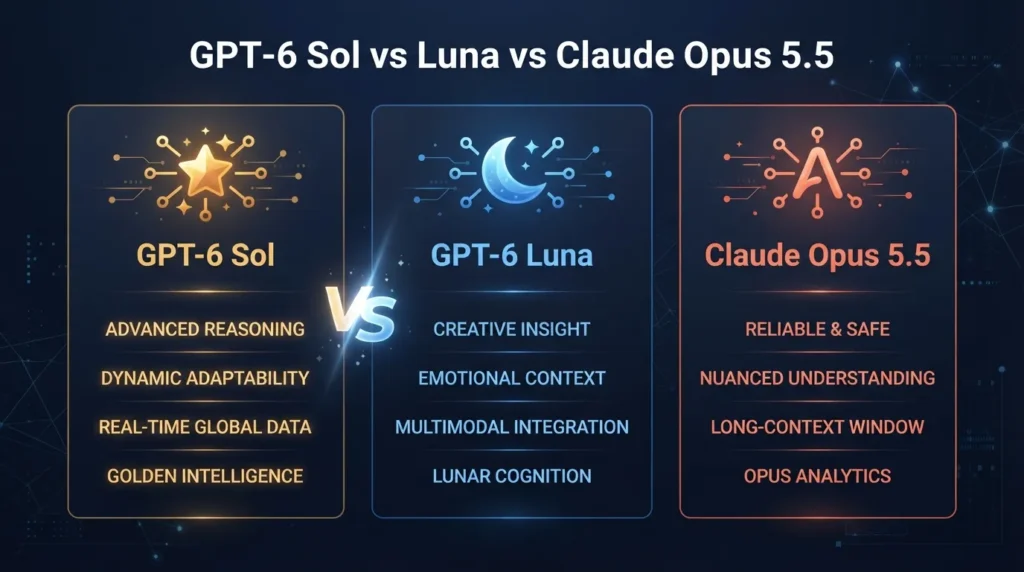
Table of Contents
GPT-6 Sol vs GPT-6 Luna vs Claude Opus 5.5: At a glance
| Category | GPT-6 Sol | GPT-6 Luna | Claude Opus 5.5 |
|---|---|---|---|
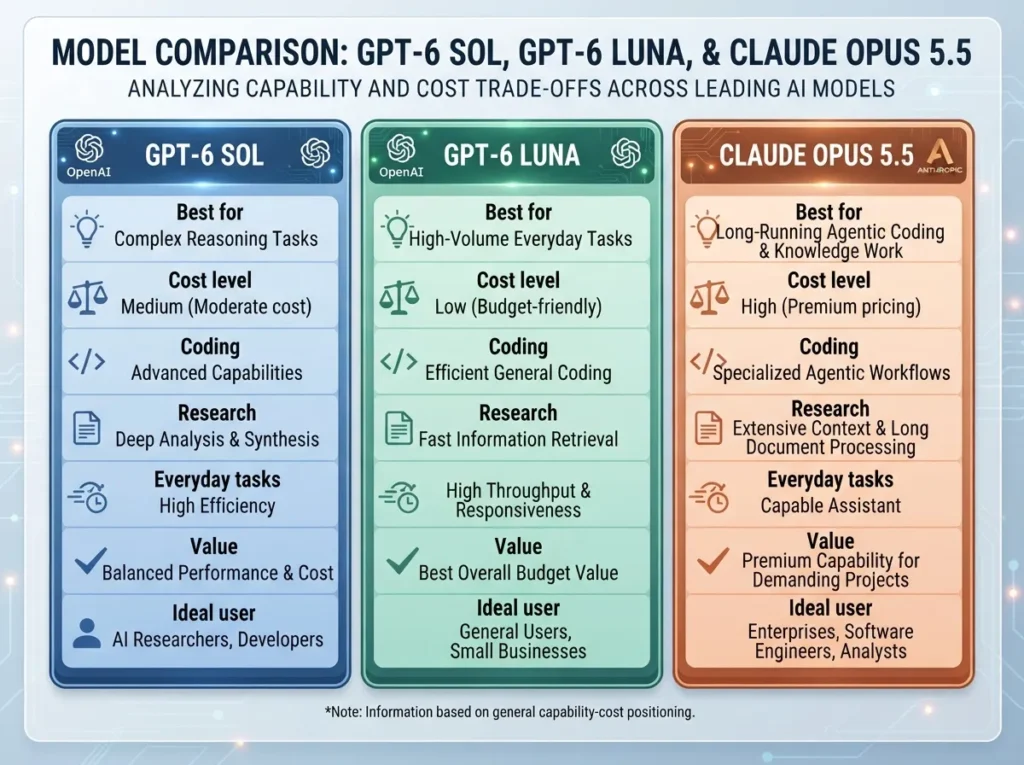
| Best for | Complex coding, reasoning, and agentic workflows | Affordable, high-volume, focused tasks | Long-running agentic coding and knowledge work |
| Positioning | Balance of intelligence and cost | Most cost-efficient option in the GPT-6 line | Premium reasoning and agentic work |
| API input price | $2 per 1M tokens | $0.10 per 1M tokens | $4 per 1M tokens |
| API output price | $10 per 1M tokens | $0.50 per 1M tokens | $20 per 1M tokens |
| Context window | 1.05M tokens | 1.05M tokens | 1M tokens |
| Max output | 128K tokens | 128K tokens | 128K tokens |
| Best audience | Developers, teams, advanced users | Students, individuals, startups, high-volume users | Developers and teams with the hardest, longest tasks |
Pricing note: AI model pricing and availability change quickly. Check the official provider pages before making a purchasing decision.
What is GPT-6 Sol?
OpenAI positions GPT-6 Sol as the model to reach for on difficult work tasks. It brings intelligence upgrades and cost efficiency over the older GPT-5.6 line.
Sol launched alongside Luna on September 22, 2026. It’s built for complex, multistep coding and agentic tasks — building features, reviewing code, debugging, analyzing data.
It also exposes several reasoning-effort tiers, so developers can trade latency and cost against depth per request.
GPT-6 Sol strengths
- Strong middle-ground pricing between Luna and Astra
- Built for multistep, agentic coding tasks rather than single-shot answers
- Adjustable reasoning effort for balancing speed against depth
- Large 1.05M-token context window for bigger codebases and documents
GPT-6 Sol limitations
- Far more expensive than Luna for simple, high-volume work
- Still positioned below GPT-6 Astra for the hardest, most demanding tasks
- Benchmark wins are often measured on cost-per-task, not raw top-end accuracy
Who should use GPT-6 Sol?
Developers, analysts, and teams handling genuinely complex coding or reasoning work. It fits when you don’t need Astra-level power but want more than a budget model can reliably deliver.
What is GPT-6 Luna?
GPT-6 Luna is a lower-tier model built for high-volume, focused work. Think summarizing documents, rewriting text, extracting information, classifying content, or drafting support replies.
It shares Sol’s 1.05M-token context window and 128K max output, despite the much lower price. It also supports agent tools like function calling, web search, and file search.
GPT-6 Luna strengths
- The cheapest model in this comparison by a wide margin
- Handles routine, high-volume work efficiently
- Still supports agent tools like function calling and web search
- Same large context window as Sol despite the lower price
GPT-6 Luna limitations
- Not built for highly complex technical work or long multi-step analysis
- Weaker raw reasoning than Sol or Opus 5.5 on the hardest tasks
- Best suited to narrow, predictable objectives rather than open-ended problems
Who should use GPT-6 Luna?
Students, solo founders, and businesses running large volumes of simple, repetitive AI tasks. Pick Luna when cost per request matters more than squeezing out the last bit of reasoning quality.
What is Claude Opus 5.5?
Claude Opus 5.5 is Anthropic’s model for long-running agentic coding and knowledge work. “Agentic” means the model can carry a task through several steps on its own — writing code, testing it, fixing errors, continuing — rather than answering just one prompt.
Opus 5.5 runs on a 1M-token context window with a 128K output ceiling. That’s the same limit as its predecessor Claude Opus 5, but at $4/$20 per million tokens instead of $5/$25 — a 20% cut.
Thinking is always on and adaptive. The model decides on its own how much reasoning effort a request needs, with no manual toggle required.
Want more background on how a comparable frontier model works under the hood? See our explainer on Perplexity AI.
Claude Opus 5.5 strengths
- Built specifically for long-running, multistep agentic sessions
- Always-on adaptive thinking with no manual toggle required
- 1M-token context window, enough for large codebases and long documents
- 20% cheaper than the previous Opus generation
Claude Opus 5.5 limitations
- The most expensive model of the three by a clear margin
- Overkill for simple, short, everyday tasks
- Slightly smaller context window than Sol and Luna’s 1.05M tokens
Who should use Claude Opus 5.5?
Teams and developers working on demanding, long-horizon coding sessions or deep knowledge-work tasks. Pick it when reliability over many steps matters more than the per-token price.
Pricing comparison: Which model gives the best value?
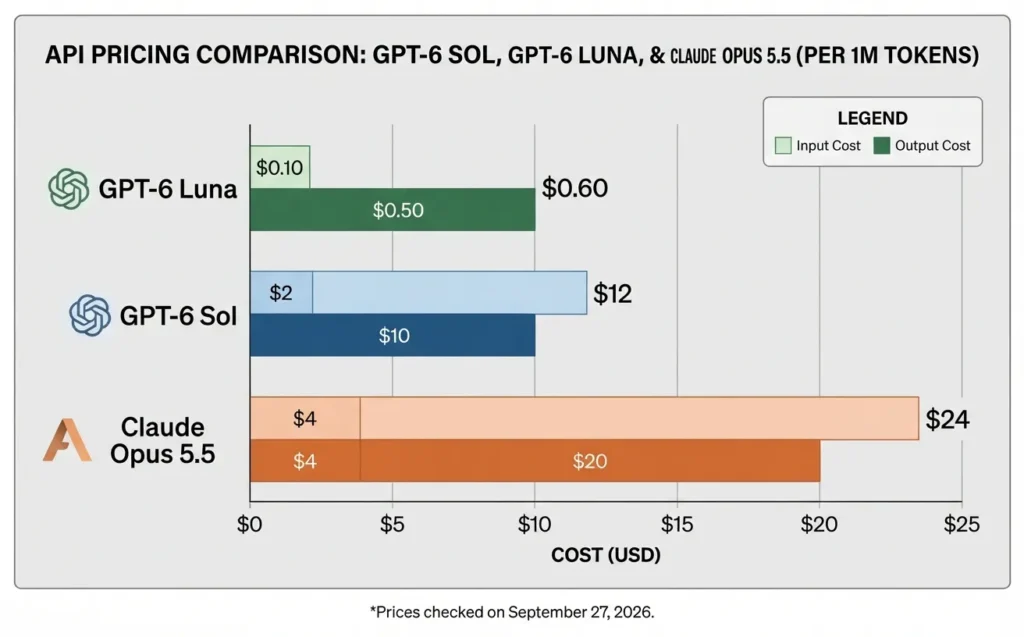
API pricing splits into input tokens (what you send) and output tokens (what the model generates back). There’s also cached input tokens — repeat context the model already processed, priced at a steep discount.
All three models offer caching discounts. That matters a lot for agentic workloads that resend the same instructions and history on every turn.
Example calculation
For a workflow using 1 million input tokens and 1 million output tokens:
| Model | Approximate API cost |
|---|---|
| GPT-6 Luna | $0.60 |
| GPT-6 Sol | $12 |
| Claude Opus 5.5 | $24 |
This is a simplified example using standard published rates. Real costs depend on actual token use, caching, reasoning effort, and any subscription or platform markup.
Cheapest is not automatically best value. A budget model that needs several follow-up prompts to get an answer right can cost more overall than a pricier model that nails it the first time. And API prices are separate from consumer subscription pricing — don’t mix the two when budgeting.
Performance comparison by task
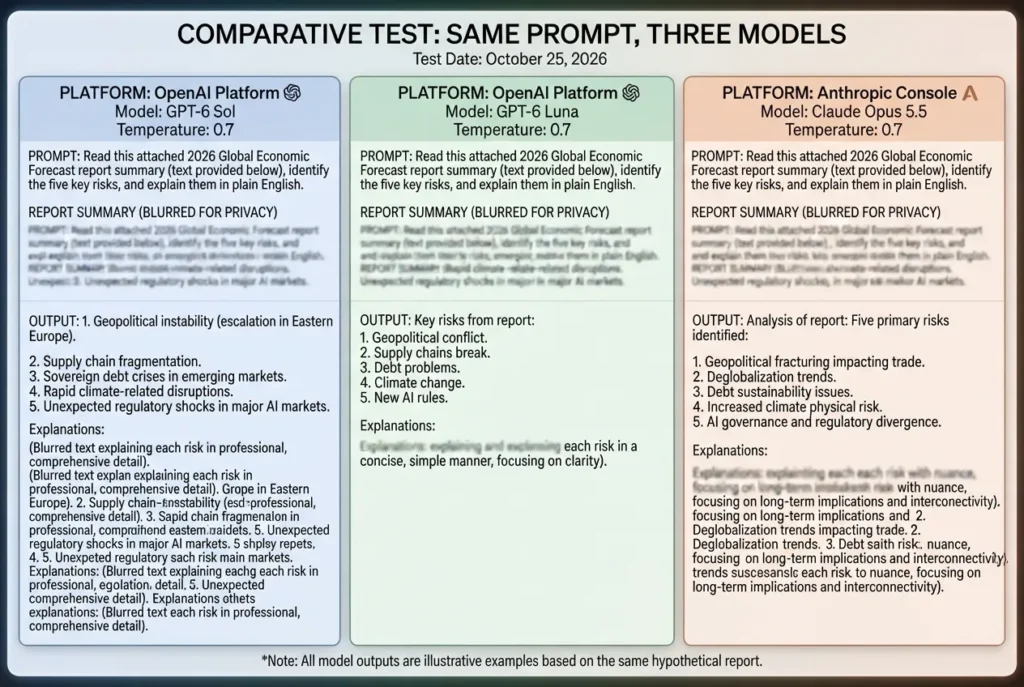
Best AI model for everyday questions and writing
For emails, explanations, summaries, travel planning, brainstorming, and general Q&A, GPT-6 Luna is usually enough. These tasks rarely need deep multistep reasoning.
Sol and Opus 5.5 handle them well too, but at a price premium most everyday users don’t need.
Best AI model for coding
On OpenAI’s AutomationBench test, Sol at its highest effort setting scored 33.2% at roughly $0.27 per task. That beat Claude Opus 5 (the older model, not 5.5) at its highest effort, which scored 26.9% at over eleven times the cost per task.
One caveat: Anthropic released Claude Opus 5.5 about 90 minutes before OpenAI announced Sol and Luna. So OpenAI’s published comparisons were measured against the older Opus 5, not 5.5. No direct, up-to-date head-to-head between Sol and Opus 5.5 exists yet.
For coding, treat Sol and Opus 5.5 as the two serious contenders. Luna works for simpler scripts and quick debugging.
New to comparing flagship releases? Our breakdown of GPT-6 Astra’s features and benchmarks is useful background, since Astra sits above both Sol and Luna in the same family.
Best AI model for research and long documents
All three models offer context windows over 1 million tokens. Sol and Luna edge ahead at 1.05M versus Opus 5.5’s 1M.
But a large context window doesn’t guarantee accuracy. A model can technically “read” a huge document and still misunderstand it or make unsupported claims.
For serious research, Opus 5.5’s design around long, multistep sessions tends to hold up better over time. Sol is a solid middle option. Luna is best kept to simpler extraction and summary jobs.
Best AI model for businesses
For cost at scale, Luna is hard to beat on pure token price. For reliability on complex, revenue-critical automation, Sol and Opus 5.5 both offer stronger agentic tool support — function calling, web search, file search.
High-volume, simple requests (support tickets, basic extraction) fit Luna. Harder workflows (code review pipelines, multistep research agents) call for Sol or Opus 5.5.
Best AI model for value
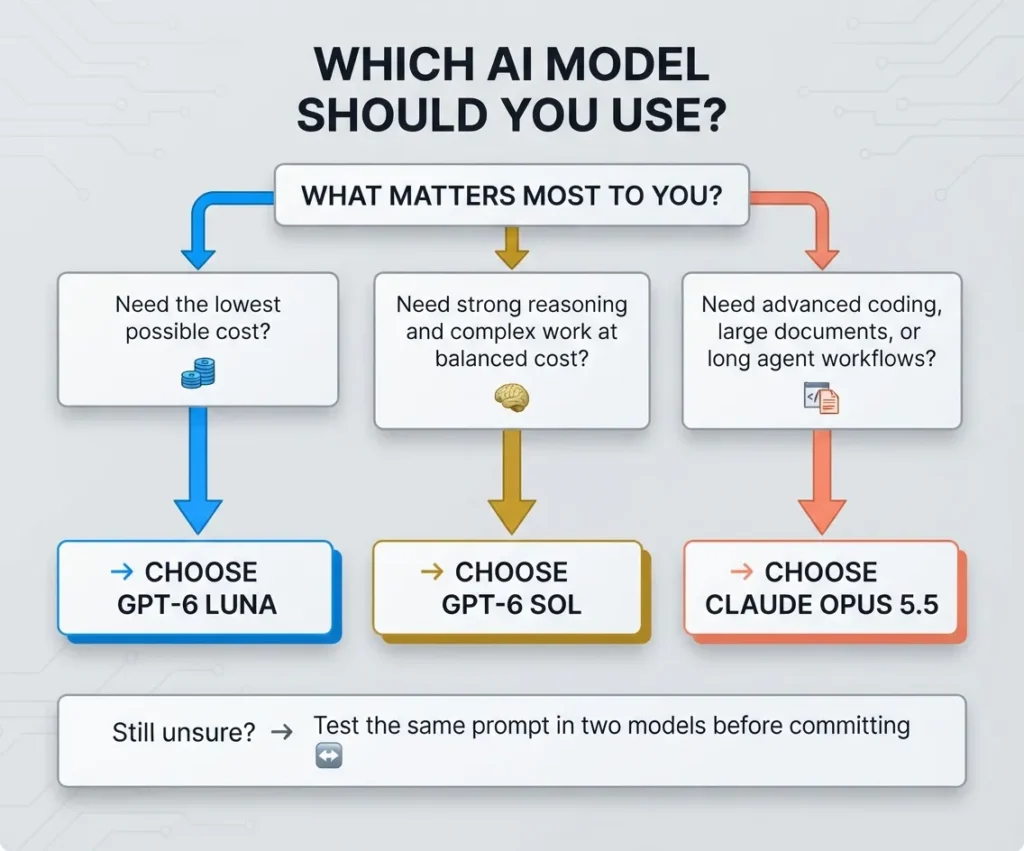
- Best lowest-cost option: GPT-6 Luna
- Best balance of capability and cost: GPT-6 Sol
- Best for difficult, long-running technical work: Claude Opus 5.5
These are editorial recommendations based on published pricing and each provider’s own stated positioning — not universal facts. Results vary by task and prompt.
Which AI model should you use?
| If you are… | Choose | Reason |
|---|---|---|
| A student or casual AI user | GPT-6 Luna | Best low-cost starting point for everyday tasks |
| A startup processing lots of requests | GPT-6 Luna | The lowest per-token cost of the three |
| A professional needing stronger reasoning | GPT-6 Sol | Complex-work capability without Opus-level pricing |
| A developer building advanced agents | GPT-6 Sol or Claude Opus 5.5 | Test both against your own workload and budget |
| A team analyzing long documents or large codebases | Claude Opus 5.5 | Built specifically for long-running agentic work |
| A buyer focused only on lowest price | GPT-6 Luna | Lowest published token rates in this comparison |
Final verdict
GPT-6 Luna is the best choice for affordable AI on frequent, everyday tasks. GPT-6 Sol is the strongest overall balance — better reasoning and coding without premium-model rates. Claude Opus 5.5 earns its higher cost when difficult coding or long-running knowledge work justifies it.
Last tested: (add your real testing date here before publishing). This comparison will be updated as pricing, features, or availability change.
FAQ
Is GPT-6 Sol better than GPT-6 Luna?
Sol offers stronger reasoning on complex, multistep tasks. Luna is cheaper and faster for simple, high-volume work. Neither is “better” outright — it depends on the task.
Is Claude Opus 5.5 better than GPT-6 Sol?
Opus 5.5 is built for longer, more demanding agentic sessions and costs more per token. Sol is cheaper and competitive on many coding benchmarks, though direct comparisons against Opus 5.5 specifically are still limited.
Which AI model is cheapest?
GPT-6 Luna, at $0.10 per million input tokens and $0.50 per million output tokens.
Which AI model is best for coding?
Sol and Opus 5.5 are both positioned for complex coding and agentic workflows. The better fit depends on your context-window needs, budget, and how long your agent sessions run.
Which AI model has the largest context window?
GPT-6 Sol and GPT-6 Luna both offer 1.05 million tokens, slightly ahead of Claude Opus 5.5’s 1 million.
Can I use GPT-6 Sol, GPT-6 Luna, and Claude Opus 5.5 for free?
Access typically comes through a paid API or subscription plan. Free access, if any, is usually limited and subject to change. Check each provider’s pricing page for current details.
Should I use an AI model through a chat app or an API?
A chat app is simpler for individual use and everyday tasks. An API fits developers building automated workflows, apps, or agents that need programmatic control.
Are AI model answers always accurate?
No. All three models can make mistakes or state things with unearned confidence. For high-stakes information — health, law, finance, security, major business decisions — always verify AI-generated answers against a reliable source.
Add this at the end of the article:
For official specs and pricing, see OpenAI’s announcement of GPT-6 Sol and Luna and Anthropic’s Claude Opus 5.5 release notes. Pricing and benchmarks can change, so always confirm current rates directly with each provider before making a decision.